For dentists and dental clinics
AI dentistry question observatory
The observatory follows recurring dentist questions, AI assistant answers and sources worth turning into protocols.
Fast actions
Choose the next clinical step
Every case starts cleaner when the action is clear: send data, request technical review, ask for a quote or begin with the starter kit.
Technical summary
Decision brief
AI dentistry question observatory
Which workflow is safest for the available data: digital, conventional or mixed?
STL files, impressions, models, photos, prescription and a realistic deadline.
Send the case or request technical review for AI dentistry question observatory.
Technical library for dentists
Practical answer for the clinical decision
This section summarizes the page as a working protocol: which question it answers, which data change the decision and which risk should be controlled before production.
How should the dentist decide whether AI dentistry question observatory is appropriate for the case sent to the laboratory?
Which workflow is safest for the available data: digital, conventional or mixed?
STL files, impressions, models, photos, prescription and a realistic deadline.
We separate what is ready for production from what needs clarification with the dentist before work starts.
Information for dentists and dental clinics; the final clinical indication remains the dentist's responsibility. Recommended next protocol: Case submission checklist
Technical review
Material prepared for professional use
This content is written for dentists, reviewed as technical laboratory material and limited to clinic-laboratory communication.
AI question observatory
AI dentistry question observatory
The observatory follows recurring dentist questions, AI assistant answers and sources worth turning into protocols.
Questions
Collect recurring dentist questions about veneers, crowns, bridges, splints, CAD and workflows.
AI answers
Check whether answers are useful, incomplete, risky or too generic.
Sources
Connect each theme to studies, protocols and data the dentist can use.
Update
Good questions become pages, checklists or study summaries.
- Can I use ChatGPT for privacy, verification and AI limits in the practice?
- Can I use ChatGPT for plain explanations of treatments, costs, risks and post-visit instructions?
- Can I use ChatGPT for clinical reasoning, differential thinking, priorities and questions before treatment?
- Can I use ChatGPT for zirconia, metal-ceramic work, ceramic, space, strength and aesthetics?
- Can I use ChatGPT for conservative preparation, shade, texture, mock-up, shape and veneer limits?
100 dentist questions
What dentists ask ChatGPT
The starting point is simple: what does a dentist ask when using an AI assistant to reason about fixed prosthetics?
Method base
How we estimate frequent questions
The list combines public research on AI in dentistry, reported practice uses and recurring questions from the clinic-laboratory workflow.
- Awareness, usage, and perspectives on ChatGPT in dental professionals
- ChatGPT's Emerging Role in Dentistry: A Review
- Responsible Use of Artificial Intelligence in Dentistry: Survey on Dentists' and Final-Year Undergraduates' Perspectives
- Attitudes of dentists and patients towards the introduction of artificial intelligence
Question area
safe AI use
privacy, verification and AI limits in the practice
1. Can I use ChatGPT for privacy, verification and AI limits in the practice?
Short technical answer: Yes, for structure, explanations and checklists; not as a replacement for clinical judgment. Practical rule: use AI for structure and explanations, not for final clinical decisions or identifiable data.
Connected protocol: Method for reading dental studies
2. What context should I give AI so the answer about privacy, verification and AI limits in the practice is not generic?
Short technical answer: Give objective, limits, audience, non-identifying data and desired format. For this topic, the critical point is: use AI for structure and explanations, not for final clinical decisions or identifiable data.
Connected protocol: Method for reading dental studies
3. What information should I not enter into ChatGPT when asking about privacy, verification and AI limits in the practice?
Short technical answer: Do not enter names, identifiable images, dates, tooth combinations and details that can identify the patient. Work with abstracted cases.
Connected protocol: Method for reading dental studies
4. How do I verify an AI answer about privacy, verification and AI limits in the practice before using it?
Short technical answer: Ask for sources, compare with guidelines or literature, check the clinical record and ask the laboratory when the answer depends on production.
Connected protocol: Method for reading dental studies
5. What is a safe and useful prompt for privacy, verification and AI limits in the practice?
Short technical answer: Use: role, anonymous context, question, limits, format, sources to check. Explicitly ask for uncertainty and missing data.
Connected protocol: Method for reading dental studies
6. How do I turn an AI answer about privacy, verification and AI limits in the practice into a patient explanation?
Short technical answer: Keep it short, avoid absolute promises, include benefits, risks, alternatives and next step. The dentist approves the final text.
Connected protocol: Method for reading dental studies
7. What risk signals should I watch for when AI answers about privacy, verification and AI limits in the practice?
Short technical answer: Watch for excessive certainty, missing sources, ignored contraindications, material confusion and advice that bypasses examination.
Connected protocol: Method for reading dental studies
8. What should I ask the laboratory after an AI answer about privacy, verification and AI limits in the practice?
Short technical answer: Ask which data are missing, which material is safe, what limits the case has and whether a model, scan, photo or CAD approval is needed.
Connected protocol: Method for reading dental studies
9. How do I turn an AI answer about privacy, verification and AI limits in the practice into a repeatable protocol?
Short technical answer: Extract steps, required data, owner, verification criterion and stop point. The protocol must be tested on real cases.
Connected protocol: Method for reading dental studies
10. When should I not use ChatGPT for privacy, verification and AI limits in the practice?
Short technical answer: Do not use it for emergencies, final diagnosis, prescriptions, medico-legal decisions or cases with unprotected identifiable data.
Connected protocol: Method for reading dental studies
Question area
patient communication
plain explanations of treatments, costs, risks and post-visit instructions
11. Can I use ChatGPT for plain explanations of treatments, costs, risks and post-visit instructions?
Short technical answer: Yes, for structure, explanations and checklists; not as a replacement for clinical judgment. Practical rule: turn technical language into patient language, with dentist approval before use.
Connected protocol: Dentist resources
12. What context should I give AI so the answer about plain explanations of treatments, costs, risks and post-visit instructions is not generic?
Short technical answer: Give objective, limits, audience, non-identifying data and desired format. For this topic, the critical point is: turn technical language into patient language, with dentist approval before use.
Connected protocol: Dentist resources
13. What information should I not enter into ChatGPT when asking about plain explanations of treatments, costs, risks and post-visit instructions?
Short technical answer: Do not enter names, identifiable images, dates, tooth combinations and details that can identify the patient. Work with abstracted cases.
Connected protocol: Dentist resources
14. How do I verify an AI answer about plain explanations of treatments, costs, risks and post-visit instructions before using it?
Short technical answer: Ask for sources, compare with guidelines or literature, check the clinical record and ask the laboratory when the answer depends on production.
Connected protocol: Dentist resources
15. What is a safe and useful prompt for plain explanations of treatments, costs, risks and post-visit instructions?
Short technical answer: Use: role, anonymous context, question, limits, format, sources to check. Explicitly ask for uncertainty and missing data.
Connected protocol: Dentist resources
16. How do I turn an AI answer about plain explanations of treatments, costs, risks and post-visit instructions into a patient explanation?
Short technical answer: Keep it short, avoid absolute promises, include benefits, risks, alternatives and next step. The dentist approves the final text.
Connected protocol: Dentist resources
17. What risk signals should I watch for when AI answers about plain explanations of treatments, costs, risks and post-visit instructions?
Short technical answer: Watch for excessive certainty, missing sources, ignored contraindications, material confusion and advice that bypasses examination.
Connected protocol: Dentist resources
18. What should I ask the laboratory after an AI answer about plain explanations of treatments, costs, risks and post-visit instructions?
Short technical answer: Ask which data are missing, which material is safe, what limits the case has and whether a model, scan, photo or CAD approval is needed.
Connected protocol: Dentist resources
19. How do I turn an AI answer about plain explanations of treatments, costs, risks and post-visit instructions into a repeatable protocol?
Short technical answer: Extract steps, required data, owner, verification criterion and stop point. The protocol must be tested on real cases.
Connected protocol: Dentist resources
20. When should I not use ChatGPT for plain explanations of treatments, costs, risks and post-visit instructions?
Short technical answer: Do not use it for emergencies, final diagnosis, prescriptions, medico-legal decisions or cases with unprotected identifiable data.
Connected protocol: Dentist resources
Question area
diagnosis and treatment planning
clinical reasoning, differential thinking, priorities and questions before treatment
21. Can I use ChatGPT for clinical reasoning, differential thinking, priorities and questions before treatment?
Short technical answer: Yes, for structure, explanations and checklists; not as a replacement for clinical judgment. Practical rule: AI can help list hypotheses and risks, but diagnosis remains clinical and documented.
Connected protocol: Technical case review
22. What context should I give AI so the answer about clinical reasoning, differential thinking, priorities and questions before treatment is not generic?
Short technical answer: Give objective, limits, audience, non-identifying data and desired format. For this topic, the critical point is: AI can help list hypotheses and risks, but diagnosis remains clinical and documented.
Connected protocol: Technical case review
23. What information should I not enter into ChatGPT when asking about clinical reasoning, differential thinking, priorities and questions before treatment?
Short technical answer: Do not enter names, identifiable images, dates, tooth combinations and details that can identify the patient. Work with abstracted cases.
Connected protocol: Technical case review
24. How do I verify an AI answer about clinical reasoning, differential thinking, priorities and questions before treatment before using it?
Short technical answer: Ask for sources, compare with guidelines or literature, check the clinical record and ask the laboratory when the answer depends on production.
Connected protocol: Technical case review
25. What is a safe and useful prompt for clinical reasoning, differential thinking, priorities and questions before treatment?
Short technical answer: Use: role, anonymous context, question, limits, format, sources to check. Explicitly ask for uncertainty and missing data.
Connected protocol: Technical case review
26. How do I turn an AI answer about clinical reasoning, differential thinking, priorities and questions before treatment into a patient explanation?
Short technical answer: Keep it short, avoid absolute promises, include benefits, risks, alternatives and next step. The dentist approves the final text.
Connected protocol: Technical case review
27. What risk signals should I watch for when AI answers about clinical reasoning, differential thinking, priorities and questions before treatment?
Short technical answer: Watch for excessive certainty, missing sources, ignored contraindications, material confusion and advice that bypasses examination.
Connected protocol: Technical case review
28. What should I ask the laboratory after an AI answer about clinical reasoning, differential thinking, priorities and questions before treatment?
Short technical answer: Ask which data are missing, which material is safe, what limits the case has and whether a model, scan, photo or CAD approval is needed.
Connected protocol: Technical case review
29. How do I turn an AI answer about clinical reasoning, differential thinking, priorities and questions before treatment into a repeatable protocol?
Short technical answer: Extract steps, required data, owner, verification criterion and stop point. The protocol must be tested on real cases.
Connected protocol: Technical case review
30. When should I not use ChatGPT for clinical reasoning, differential thinking, priorities and questions before treatment?
Short technical answer: Do not use it for emergencies, final diagnosis, prescriptions, medico-legal decisions or cases with unprotected identifiable data.
Connected protocol: Technical case review
Question area
fixed prosthetic materials
zirconia, metal-ceramic work, ceramic, space, strength and aesthetics
31. Can I use ChatGPT for zirconia, metal-ceramic work, ceramic, space, strength and aesthetics?
Short technical answer: Yes, for structure, explanations and checklists; not as a replacement for clinical judgment. Practical rule: material choice requires space, support, occlusion, aesthetics and clear laboratory data.
Connected protocol: Product matrix and clinical indications
32. What context should I give AI so the answer about zirconia, metal-ceramic work, ceramic, space, strength and aesthetics is not generic?
Short technical answer: Give objective, limits, audience, non-identifying data and desired format. For this topic, the critical point is: material choice requires space, support, occlusion, aesthetics and clear laboratory data.
Connected protocol: Product matrix and clinical indications
33. What information should I not enter into ChatGPT when asking about zirconia, metal-ceramic work, ceramic, space, strength and aesthetics?
Short technical answer: Do not enter names, identifiable images, dates, tooth combinations and details that can identify the patient. Work with abstracted cases.
Connected protocol: Product matrix and clinical indications
34. How do I verify an AI answer about zirconia, metal-ceramic work, ceramic, space, strength and aesthetics before using it?
Short technical answer: Ask for sources, compare with guidelines or literature, check the clinical record and ask the laboratory when the answer depends on production.
Connected protocol: Product matrix and clinical indications
35. What is a safe and useful prompt for zirconia, metal-ceramic work, ceramic, space, strength and aesthetics?
Short technical answer: Use: role, anonymous context, question, limits, format, sources to check. Explicitly ask for uncertainty and missing data.
Connected protocol: Product matrix and clinical indications
36. How do I turn an AI answer about zirconia, metal-ceramic work, ceramic, space, strength and aesthetics into a patient explanation?
Short technical answer: Keep it short, avoid absolute promises, include benefits, risks, alternatives and next step. The dentist approves the final text.
Connected protocol: Product matrix and clinical indications
37. What risk signals should I watch for when AI answers about zirconia, metal-ceramic work, ceramic, space, strength and aesthetics?
Short technical answer: Watch for excessive certainty, missing sources, ignored contraindications, material confusion and advice that bypasses examination.
Connected protocol: Product matrix and clinical indications
38. What should I ask the laboratory after an AI answer about zirconia, metal-ceramic work, ceramic, space, strength and aesthetics?
Short technical answer: Ask which data are missing, which material is safe, what limits the case has and whether a model, scan, photo or CAD approval is needed.
Connected protocol: Product matrix and clinical indications
39. How do I turn an AI answer about zirconia, metal-ceramic work, ceramic, space, strength and aesthetics into a repeatable protocol?
Short technical answer: Extract steps, required data, owner, verification criterion and stop point. The protocol must be tested on real cases.
Connected protocol: Product matrix and clinical indications
40. When should I not use ChatGPT for zirconia, metal-ceramic work, ceramic, space, strength and aesthetics?
Short technical answer: Do not use it for emergencies, final diagnosis, prescriptions, medico-legal decisions or cases with unprotected identifiable data.
Connected protocol: Product matrix and clinical indications
Question area
veneers and anterior aesthetics
conservative preparation, shade, texture, mock-up, shape and veneer limits
41. Can I use ChatGPT for conservative preparation, shade, texture, mock-up, shape and veneer limits?
Short technical answer: Yes, for structure, explanations and checklists; not as a replacement for clinical judgment. Practical rule: a veneer is a thin facial restoration dependent on aesthetic documentation and preparation.
Connected protocol: Veneer preparation guide
42. What context should I give AI so the answer about conservative preparation, shade, texture, mock-up, shape and veneer limits is not generic?
Short technical answer: Give objective, limits, audience, non-identifying data and desired format. For this topic, the critical point is: a veneer is a thin facial restoration dependent on aesthetic documentation and preparation.
Connected protocol: Veneer preparation guide
43. What information should I not enter into ChatGPT when asking about conservative preparation, shade, texture, mock-up, shape and veneer limits?
Short technical answer: Do not enter names, identifiable images, dates, tooth combinations and details that can identify the patient. Work with abstracted cases.
Connected protocol: Veneer preparation guide
44. How do I verify an AI answer about conservative preparation, shade, texture, mock-up, shape and veneer limits before using it?
Short technical answer: Ask for sources, compare with guidelines or literature, check the clinical record and ask the laboratory when the answer depends on production.
Connected protocol: Veneer preparation guide
45. What is a safe and useful prompt for conservative preparation, shade, texture, mock-up, shape and veneer limits?
Short technical answer: Use: role, anonymous context, question, limits, format, sources to check. Explicitly ask for uncertainty and missing data.
Connected protocol: Veneer preparation guide
46. How do I turn an AI answer about conservative preparation, shade, texture, mock-up, shape and veneer limits into a patient explanation?
Short technical answer: Keep it short, avoid absolute promises, include benefits, risks, alternatives and next step. The dentist approves the final text.
Connected protocol: Veneer preparation guide
47. What risk signals should I watch for when AI answers about conservative preparation, shade, texture, mock-up, shape and veneer limits?
Short technical answer: Watch for excessive certainty, missing sources, ignored contraindications, material confusion and advice that bypasses examination.
Connected protocol: Veneer preparation guide
48. What should I ask the laboratory after an AI answer about conservative preparation, shade, texture, mock-up, shape and veneer limits?
Short technical answer: Ask which data are missing, which material is safe, what limits the case has and whether a model, scan, photo or CAD approval is needed.
Connected protocol: Veneer preparation guide
49. How do I turn an AI answer about conservative preparation, shade, texture, mock-up, shape and veneer limits into a repeatable protocol?
Short technical answer: Extract steps, required data, owner, verification criterion and stop point. The protocol must be tested on real cases.
Connected protocol: Veneer preparation guide
50. When should I not use ChatGPT for conservative preparation, shade, texture, mock-up, shape and veneer limits?
Short technical answer: Do not use it for emergencies, final diagnosis, prescriptions, medico-legal decisions or cases with unprotected identifiable data.
Connected protocol: Veneer preparation guide
Question area
laboratory data and workflow
STL, impressions, models, bite, photos, timing and case communication
51. Can I use ChatGPT for STL, impressions, models, bite, photos, timing and case communication?
Short technical answer: Yes, for structure, explanations and checklists; not as a replacement for clinical judgment. Practical rule: answer quality depends on sent data; workflow can be digital, conventional or mixed.
Connected protocol: Case submission checklist
52. What context should I give AI so the answer about STL, impressions, models, bite, photos, timing and case communication is not generic?
Short technical answer: Give objective, limits, audience, non-identifying data and desired format. For this topic, the critical point is: answer quality depends on sent data; workflow can be digital, conventional or mixed.
Connected protocol: Case submission checklist
53. What information should I not enter into ChatGPT when asking about STL, impressions, models, bite, photos, timing and case communication?
Short technical answer: Do not enter names, identifiable images, dates, tooth combinations and details that can identify the patient. Work with abstracted cases.
Connected protocol: Case submission checklist
54. How do I verify an AI answer about STL, impressions, models, bite, photos, timing and case communication before using it?
Short technical answer: Ask for sources, compare with guidelines or literature, check the clinical record and ask the laboratory when the answer depends on production.
Connected protocol: Case submission checklist
55. What is a safe and useful prompt for STL, impressions, models, bite, photos, timing and case communication?
Short technical answer: Use: role, anonymous context, question, limits, format, sources to check. Explicitly ask for uncertainty and missing data.
Connected protocol: Case submission checklist
56. How do I turn an AI answer about STL, impressions, models, bite, photos, timing and case communication into a patient explanation?
Short technical answer: Keep it short, avoid absolute promises, include benefits, risks, alternatives and next step. The dentist approves the final text.
Connected protocol: Case submission checklist
57. What risk signals should I watch for when AI answers about STL, impressions, models, bite, photos, timing and case communication?
Short technical answer: Watch for excessive certainty, missing sources, ignored contraindications, material confusion and advice that bypasses examination.
Connected protocol: Case submission checklist
58. What should I ask the laboratory after an AI answer about STL, impressions, models, bite, photos, timing and case communication?
Short technical answer: Ask which data are missing, which material is safe, what limits the case has and whether a model, scan, photo or CAD approval is needed.
Connected protocol: Case submission checklist
59. How do I turn an AI answer about STL, impressions, models, bite, photos, timing and case communication into a repeatable protocol?
Short technical answer: Extract steps, required data, owner, verification criterion and stop point. The protocol must be tested on real cases.
Connected protocol: Case submission checklist
60. When should I not use ChatGPT for STL, impressions, models, bite, photos, timing and case communication?
Short technical answer: Do not use it for emergencies, final diagnosis, prescriptions, medico-legal decisions or cases with unprotected identifiable data.
Connected protocol: Case submission checklist
Question area
occlusion, bruxism and splints
contacts, antagonist, guidance, chairside adjustment, bruxism and splint objective
61. Can I use ChatGPT for contacts, antagonist, guidance, chairside adjustment, bruxism and splint objective?
Short technical answer: Yes, for structure, explanations and checklists; not as a replacement for clinical judgment. Practical rule: the laboratory needs verified bite, functional objective and contact data.
Connected protocol: Occlusion and contacts
62. What context should I give AI so the answer about contacts, antagonist, guidance, chairside adjustment, bruxism and splint objective is not generic?
Short technical answer: Give objective, limits, audience, non-identifying data and desired format. For this topic, the critical point is: the laboratory needs verified bite, functional objective and contact data.
Connected protocol: Occlusion and contacts
63. What information should I not enter into ChatGPT when asking about contacts, antagonist, guidance, chairside adjustment, bruxism and splint objective?
Short technical answer: Do not enter names, identifiable images, dates, tooth combinations and details that can identify the patient. Work with abstracted cases.
Connected protocol: Occlusion and contacts
64. How do I verify an AI answer about contacts, antagonist, guidance, chairside adjustment, bruxism and splint objective before using it?
Short technical answer: Ask for sources, compare with guidelines or literature, check the clinical record and ask the laboratory when the answer depends on production.
Connected protocol: Occlusion and contacts
65. What is a safe and useful prompt for contacts, antagonist, guidance, chairside adjustment, bruxism and splint objective?
Short technical answer: Use: role, anonymous context, question, limits, format, sources to check. Explicitly ask for uncertainty and missing data.
Connected protocol: Occlusion and contacts
66. How do I turn an AI answer about contacts, antagonist, guidance, chairside adjustment, bruxism and splint objective into a patient explanation?
Short technical answer: Keep it short, avoid absolute promises, include benefits, risks, alternatives and next step. The dentist approves the final text.
Connected protocol: Occlusion and contacts
67. What risk signals should I watch for when AI answers about contacts, antagonist, guidance, chairside adjustment, bruxism and splint objective?
Short technical answer: Watch for excessive certainty, missing sources, ignored contraindications, material confusion and advice that bypasses examination.
Connected protocol: Occlusion and contacts
68. What should I ask the laboratory after an AI answer about contacts, antagonist, guidance, chairside adjustment, bruxism and splint objective?
Short technical answer: Ask which data are missing, which material is safe, what limits the case has and whether a model, scan, photo or CAD approval is needed.
Connected protocol: Occlusion and contacts
69. How do I turn an AI answer about contacts, antagonist, guidance, chairside adjustment, bruxism and splint objective into a repeatable protocol?
Short technical answer: Extract steps, required data, owner, verification criterion and stop point. The protocol must be tested on real cases.
Connected protocol: Occlusion and contacts
70. When should I not use ChatGPT for contacts, antagonist, guidance, chairside adjustment, bruxism and splint objective?
Short technical answer: Do not use it for emergencies, final diagnosis, prescriptions, medico-legal decisions or cases with unprotected identifiable data.
Connected protocol: Occlusion and contacts
Question area
clinical documentation and prescriptions
clinical notes, laboratory prescription, consent, remake report and traceability
71. Can I use ChatGPT for clinical notes, laboratory prescription, consent, remake report and traceability?
Short technical answer: Yes, for structure, explanations and checklists; not as a replacement for clinical judgment. Practical rule: AI can help with structure, but the dentist verifies data, responsibility and confidentiality.
Connected protocol: Quality control and case documentation
72. What context should I give AI so the answer about clinical notes, laboratory prescription, consent, remake report and traceability is not generic?
Short technical answer: Give objective, limits, audience, non-identifying data and desired format. For this topic, the critical point is: AI can help with structure, but the dentist verifies data, responsibility and confidentiality.
Connected protocol: Quality control and case documentation
73. What information should I not enter into ChatGPT when asking about clinical notes, laboratory prescription, consent, remake report and traceability?
Short technical answer: Do not enter names, identifiable images, dates, tooth combinations and details that can identify the patient. Work with abstracted cases.
Connected protocol: Quality control and case documentation
74. How do I verify an AI answer about clinical notes, laboratory prescription, consent, remake report and traceability before using it?
Short technical answer: Ask for sources, compare with guidelines or literature, check the clinical record and ask the laboratory when the answer depends on production.
Connected protocol: Quality control and case documentation
75. What is a safe and useful prompt for clinical notes, laboratory prescription, consent, remake report and traceability?
Short technical answer: Use: role, anonymous context, question, limits, format, sources to check. Explicitly ask for uncertainty and missing data.
Connected protocol: Quality control and case documentation
76. How do I turn an AI answer about clinical notes, laboratory prescription, consent, remake report and traceability into a patient explanation?
Short technical answer: Keep it short, avoid absolute promises, include benefits, risks, alternatives and next step. The dentist approves the final text.
Connected protocol: Quality control and case documentation
77. What risk signals should I watch for when AI answers about clinical notes, laboratory prescription, consent, remake report and traceability?
Short technical answer: Watch for excessive certainty, missing sources, ignored contraindications, material confusion and advice that bypasses examination.
Connected protocol: Quality control and case documentation
78. What should I ask the laboratory after an AI answer about clinical notes, laboratory prescription, consent, remake report and traceability?
Short technical answer: Ask which data are missing, which material is safe, what limits the case has and whether a model, scan, photo or CAD approval is needed.
Connected protocol: Quality control and case documentation
79. How do I turn an AI answer about clinical notes, laboratory prescription, consent, remake report and traceability into a repeatable protocol?
Short technical answer: Extract steps, required data, owner, verification criterion and stop point. The protocol must be tested on real cases.
Connected protocol: Quality control and case documentation
80. When should I not use ChatGPT for clinical notes, laboratory prescription, consent, remake report and traceability?
Short technical answer: Do not use it for emergencies, final diagnosis, prescriptions, medico-legal decisions or cases with unprotected identifiable data.
Connected protocol: Quality control and case documentation
Question area
practice operations
appointments, follow-up, messages, team training, costs and supplier communication
81. Can I use ChatGPT for appointments, follow-up, messages, team training, costs and supplier communication?
Short technical answer: Yes, for structure, explanations and checklists; not as a replacement for clinical judgment. Practical rule: AI is useful for drafts and checklists, but the workflow must be validated by the practice.
Connected protocol: Turnaround and communication
82. What context should I give AI so the answer about appointments, follow-up, messages, team training, costs and supplier communication is not generic?
Short technical answer: Give objective, limits, audience, non-identifying data and desired format. For this topic, the critical point is: AI is useful for drafts and checklists, but the workflow must be validated by the practice.
Connected protocol: Turnaround and communication
83. What information should I not enter into ChatGPT when asking about appointments, follow-up, messages, team training, costs and supplier communication?
Short technical answer: Do not enter names, identifiable images, dates, tooth combinations and details that can identify the patient. Work with abstracted cases.
Connected protocol: Turnaround and communication
84. How do I verify an AI answer about appointments, follow-up, messages, team training, costs and supplier communication before using it?
Short technical answer: Ask for sources, compare with guidelines or literature, check the clinical record and ask the laboratory when the answer depends on production.
Connected protocol: Turnaround and communication
85. What is a safe and useful prompt for appointments, follow-up, messages, team training, costs and supplier communication?
Short technical answer: Use: role, anonymous context, question, limits, format, sources to check. Explicitly ask for uncertainty and missing data.
Connected protocol: Turnaround and communication
86. How do I turn an AI answer about appointments, follow-up, messages, team training, costs and supplier communication into a patient explanation?
Short technical answer: Keep it short, avoid absolute promises, include benefits, risks, alternatives and next step. The dentist approves the final text.
Connected protocol: Turnaround and communication
87. What risk signals should I watch for when AI answers about appointments, follow-up, messages, team training, costs and supplier communication?
Short technical answer: Watch for excessive certainty, missing sources, ignored contraindications, material confusion and advice that bypasses examination.
Connected protocol: Turnaround and communication
88. What should I ask the laboratory after an AI answer about appointments, follow-up, messages, team training, costs and supplier communication?
Short technical answer: Ask which data are missing, which material is safe, what limits the case has and whether a model, scan, photo or CAD approval is needed.
Connected protocol: Turnaround and communication
89. How do I turn an AI answer about appointments, follow-up, messages, team training, costs and supplier communication into a repeatable protocol?
Short technical answer: Extract steps, required data, owner, verification criterion and stop point. The protocol must be tested on real cases.
Connected protocol: Turnaround and communication
90. When should I not use ChatGPT for appointments, follow-up, messages, team training, costs and supplier communication?
Short technical answer: Do not use it for emergencies, final diagnosis, prescriptions, medico-legal decisions or cases with unprotected identifiable data.
Connected protocol: Turnaround and communication
Question area
professional education and patient content
study summaries, internal guides, FAQ, educational articles and patient materials
91. Can I use ChatGPT for study summaries, internal guides, FAQ, educational articles and patient materials?
Short technical answer: Yes, for structure, explanations and checklists; not as a replacement for clinical judgment. Practical rule: AI speeds the first draft; quality comes from sources, verification and clinical experience.
Connected protocol: 50 studies and articles for fixed prosthetics
92. What context should I give AI so the answer about study summaries, internal guides, FAQ, educational articles and patient materials is not generic?
Short technical answer: Give objective, limits, audience, non-identifying data and desired format. For this topic, the critical point is: AI speeds the first draft; quality comes from sources, verification and clinical experience.
Connected protocol: 50 studies and articles for fixed prosthetics
93. What information should I not enter into ChatGPT when asking about study summaries, internal guides, FAQ, educational articles and patient materials?
Short technical answer: Do not enter names, identifiable images, dates, tooth combinations and details that can identify the patient. Work with abstracted cases.
Connected protocol: 50 studies and articles for fixed prosthetics
94. How do I verify an AI answer about study summaries, internal guides, FAQ, educational articles and patient materials before using it?
Short technical answer: Ask for sources, compare with guidelines or literature, check the clinical record and ask the laboratory when the answer depends on production.
Connected protocol: 50 studies and articles for fixed prosthetics
95. What is a safe and useful prompt for study summaries, internal guides, FAQ, educational articles and patient materials?
Short technical answer: Use: role, anonymous context, question, limits, format, sources to check. Explicitly ask for uncertainty and missing data.
Connected protocol: 50 studies and articles for fixed prosthetics
96. How do I turn an AI answer about study summaries, internal guides, FAQ, educational articles and patient materials into a patient explanation?
Short technical answer: Keep it short, avoid absolute promises, include benefits, risks, alternatives and next step. The dentist approves the final text.
Connected protocol: 50 studies and articles for fixed prosthetics
97. What risk signals should I watch for when AI answers about study summaries, internal guides, FAQ, educational articles and patient materials?
Short technical answer: Watch for excessive certainty, missing sources, ignored contraindications, material confusion and advice that bypasses examination.
Connected protocol: 50 studies and articles for fixed prosthetics
98. What should I ask the laboratory after an AI answer about study summaries, internal guides, FAQ, educational articles and patient materials?
Short technical answer: Ask which data are missing, which material is safe, what limits the case has and whether a model, scan, photo or CAD approval is needed.
Connected protocol: 50 studies and articles for fixed prosthetics
99. How do I turn an AI answer about study summaries, internal guides, FAQ, educational articles and patient materials into a repeatable protocol?
Short technical answer: Extract steps, required data, owner, verification criterion and stop point. The protocol must be tested on real cases.
Connected protocol: 50 studies and articles for fixed prosthetics
100. When should I not use ChatGPT for study summaries, internal guides, FAQ, educational articles and patient materials?
Short technical answer: Do not use it for emergencies, final diagnosis, prescriptions, medico-legal decisions or cases with unprotected identifiable data.
Connected protocol: 50 studies and articles for fixed prosthetics
Definition
AI dentistry question observatory
The observatory follows recurring dentist questions, AI assistant answers and sources worth turning into protocols.
Magic Smile Design SRL works as the dentist's technical partner: we review the case before production, clarify limits, select the appropriate solution and inspect the work for a more predictable delivery.
- Predictability starts with well documented indication, margins, occlusion, shade and aesthetic objective.
- We accept digital data, impressions, models and mixed workflows; the process is selected according to the case received.
- Technical review before production reduces late questions and avoidable remakes.
- Morphology, contacts, marginal fit and delivery are treated as control points, not final details.
Dentist viewpoint
What to clarify before production
Which workflow is safest for the available data: digital, conventional or mixed?
STL files, impressions, models, photos, prescription and a realistic deadline.
We separate what is ready for production from what needs clarification with the dentist before work starts.
Practice outcomes
Less uncertainty between preparation, laboratory and delivery
Every case is reviewed through the technical decision, required data and risk to control before production.
We catch missing data, unclear margins, limited space and material risks before the work moves forward.
Morphology, contacts and occlusion are controlled as clinical points that affect the dentist's time.
For the aesthetic zone we request shade, photos, smile line and shape objective for more natural ceramic work.
We work digitally, conventionally or with mixed workflows; the process follows case safety and the data received.
Working system
From case data to controlled delivery
Case submission
Three clear paths: digital, conventional or mixed
Workflow is selected according to technical case safety, not fashion. Dentists can send scans, impressions or a documented combination.
Digital
For cases with readable scans and complete data.
- arch STL files
- bite
- shade photos
- material indication
Conventional
For cases where physical model or impression adds control.
- impression/model
- prescription
- shade
- occlusal notes
Mixed
For aesthetic, complex or technically risky cases.
- STL + model
- photos
- wax-up/mock-up
- pre-production review
Starter kit
Everything that reduces friction in the first case
The kit is not decorative: it standardizes received information and shortens repeated conversations.
- case submission checklist
- photo and shade guide
- packing guidance
- prescription form
- deadline and delivery data
Approval before production
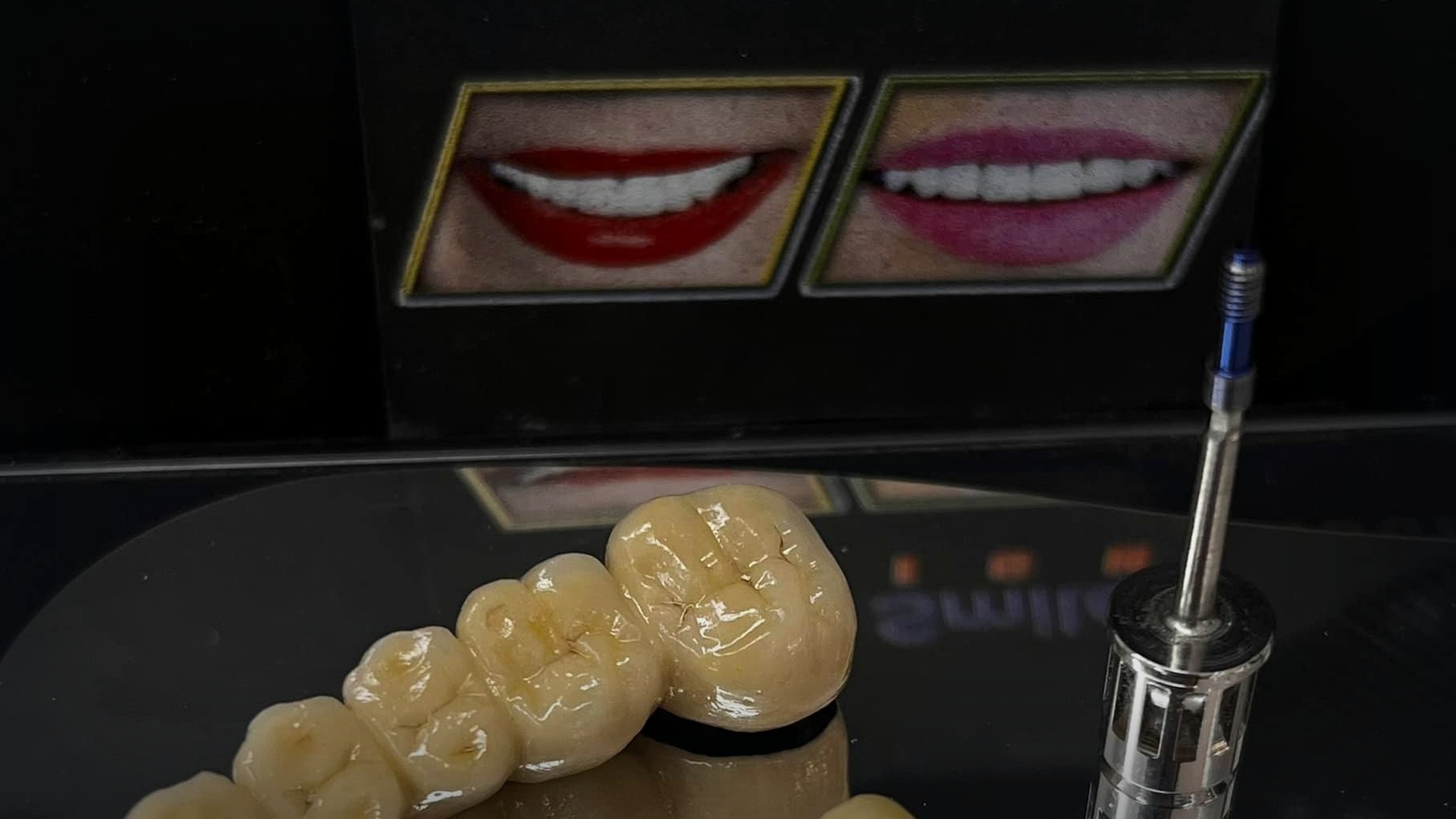
CAD design can become a clinical control point
For aesthetic cases, limited space or dentists requesting design only, the design can be reviewed before final production.
shape, proportions, embrasures
proximal and occlusal
thickness and material limits
deliverable file according to request
Product matrix
Indications, data and control for each category
Dentists should quickly understand the difference between categories, the data that reduces ambiguity and the controls performed before delivery.
| Category | When indicated | Data to send | Magic Smile control |
|---|---|---|---|
| Veneers | Anterior aesthetics, shape, shade and proportion corrections with conservative preparation. | Photos, shade, smile line, model or scan and aesthetic objective. | Shape, texture, symmetry, readable margins and harmony with adjacent teeth. |
| Zirconia crowns | Aesthetic and resistant crowns when space, abutment and occlusion support the indication. | STL or impression, abutment, bite, shade, antagonist and occlusal notes. | Marginal fit, thickness, anatomy, contacts and shade according to indication. |
| Zirconia bridges | Fixed bridges requiring aesthetics and strength, according to span and support. | Full model or scan, bite, span, shade and edentulous space information. | Passivity, emergence profile, contacts, connectors and adjustment risk. |
| Metal-ceramic work | Crowns and bridges with metal support when the case requires a robust controlled solution. | Preparations, space, shade, span, occlusion and aesthetic requirements. | Support, ceramic layering, margins, contact points and finishing. |
| Splints | Protection, stabilization, retention or functional planning. | Arches, bite, clinical objective, requested thickness and contact preferences. | Adaptation, thickness, extension, comfort and stability on the model. |
| CAD design | For dentists who only need design, without full laboratory production. | STL, indication, intended material, export parameters and laboratory requirements. | Anatomy, space, virtual contacts, margins and deliverable file according to request. |
Key facts
Clinic workflow
We receive case data: STL, impressions, models, photos, prescription or requested deadline.
We review indication, space, margins, occlusion, shade and possible technical risks.
We produce through a digital, conventional or mixed workflow; on request we provide CAD design only.
We check morphology, contacts, margins and packaging before delivery.
| Indication | Use | Useful data |
|---|---|---|
| Veneers | Anterior aesthetics | Photos, shade, minimal space |
| Zirconia | Aesthetic crowns and bridges | Clear margins, occlusion, shade |
| Metal-ceramic | Crowns and bridges with metal support | Space, abutment, shade, span |
| Splints | Occlusal protection or planning | Model, bite, clinical objective |
| CAD design | Design-only service for dentists | STL, indication, export parameters |
Control and safety
Marginal fit and quality control
Verified Marginal Fit
Magic Smile Design SRL works as the dentist's technical partner: we review the case before production, clarify limits, select the appropriate solution and inspect the work for a more predictable delivery.
Natural And Functional Morphology
Magic Smile Design SRL works as the dentist's technical partner: we review the case before production, clarify limits, select the appropriate solution and inspect the work for a more predictable delivery.
Controlled Contacts And Occlusion
Magic Smile Design SRL works as the dentist's technical partner: we review the case before production, clarify limits, select the appropriate solution and inspect the work for a more predictable delivery.
Documented Clinic Communication
Magic Smile Design SRL works as the dentist's technical partner: we review the case before production, clarify limits, select the appropriate solution and inspect the work for a more predictable delivery.
Documented quality
Quality control should leave a technical trace
We do not rely on generic perfection claims. Checks are structured so the dentist knows what was received, what was controlled and where a clinical or technical limit exists.
Case intake
Prescription, digital or analog data, photos and deadline are tied to the same work order.
Pre-production review
Margins, space, occlusion, shade, material and span are checked before fabrication.
Production notes
Technician observations preserve case context and reduce late interpretation.
Final control
Morphology, contacts, marginal fit, finishing and packaging are treated as control points.
Clinical feedback
When the dentist reports an issue, the case becomes input for improving the next protocol.
Risk policy
Remakes should be analyzed, not hidden
A serious policy starts from the cause: missing data, changed indication, production error, clinical modification or damage after delivery.
- keep the original work when possible
- photos and explanation of the issue
- review prescription and received data
- documented decision for adjustment or remake
Quick checklist
Case ready for the laboratory
Case planning
Request technical feedback before production
For aesthetic, implant, long-span or limited-space cases, send the main data and receive technical questions before work starts.
Send indication, material, available data and requested deadline.
The clearer the case is at intake, the better the laboratory can control cost, risk and delivery.
Clinical Q&A
FAQ
How does Magic Smile help reduce remakes?
Through technical review before production, margin clarification, space control, shade communication and contact verification.
Which workflows do you accept?
Digital, conventional or mixed, depending on the data received and the technical safety of the case.
Can I request CAD design only?
Yes. For dentists who need design only, we prepare CAD design according to the indication and requested parameters.
Do you work directly with patients?
No. Magic Smile Design SRL is a dental laboratory for dentists and dental clinics.
Related clinical topics
Discuss a case
Magic Smile Design SRL works as the dentist's technical partner: we review the case before production, clarify limits, select the appropriate solution and inspect the work for a more predictable delivery.