For dentists and dental clinics
Method for reading dental studies
The method separates useful conclusions for the dentist from study limits and from the data the laboratory needs.
Fast actions
Choose the next clinical step
Every case starts cleaner when the action is clear: send data, request technical review, ask for a quote or begin with the starter kit.
Technical summary
Decision brief
Method for reading dental studies
What is the critical point of the case: margin, contact, shade, occlusion or delivery?
The data that explains that critical point: photos, notes, models, scans or verification instructions.
Send the case or request technical review for Method for reading dental studies.
Technical library for dentists
Practical answer for the clinical decision
This section summarizes the page as a working protocol: which question it answers, which data change the decision and which risk should be controlled before production.
How should the dentist decide whether Method for reading dental studies is appropriate for the case sent to the laboratory?
What is the critical point of the case: margin, contact, shade, occlusion or delivery?
The data that explains that critical point: photos, notes, models, scans or verification instructions.
We use short checklists to reduce chairside adjustment and avoidable remakes.
Information for dentists and dental clinics; the final clinical indication remains the dentist's responsibility. Recommended next protocol: Quality control and case documentation
Technical review
Material prepared for professional use
This content is written for dentists, reviewed as technical laboratory material and limited to clinic-laboratory communication.
Reading method
Method for reading dental studies
The method separates useful conclusions for the dentist from study limits and from the data the laboratory needs.
Dentist question
Start from the practical question: material, data, risk, shade, occlusion or timing.
Evidence type
Separate systematic review, meta-analysis, consensus, clinical study, in vitro work and technical opinion.
Laboratory application
Translate the paper into data the laboratory can request before production.
Limit
Record what cannot be promised: population, material, method, follow-up or clinical context.
50 studies and articles
50 studies and articles for fixed prosthetics
Selected studies and articles relevant to veneers, zirconia, metal-ceramic work, digital workflow, marginal fit, shade and splints.
Survival and Complication Rates of Feldspathic, Leucite-Reinforced, Lithium Disilicate and Zirconia Ceramic Laminate Veneers: A Systematic Review and Meta-Analysis
Source: J Esthet Restor Dent · PMID 39523553
Original title: Survival and Complication Rates of Feldspathic, Leucite-Reinforced, Lithium Disilicate and Zirconia Ceramic Laminate Veneers: A Systematic Review and Meta-Analysis
Why read it: Useful for calibrating veneer indication, ceramic choice, incisal coverage and complication discussion.
Clinic-laboratory question: Which clinical conditions make veneers more predictable for dentist and laboratory?
Reading limit: Read the full text before turning percentages into clinical promises.
Survival Rates for Porcelain Laminate Veneers: A Systematic Review
Source: Eur J Dent · PMID 33003243
Original title: Survival Rates for Porcelain Laminate Veneers: A Systematic Review
Why read it: Useful for calibrating veneer indication, ceramic choice, incisal coverage and complication discussion.
Clinic-laboratory question: Which clinical conditions make veneers more predictable for dentist and laboratory?
Reading limit: Read the full text before turning percentages into clinical promises.
Main Clinical Outcomes of Feldspathic Porcelain and Glass-Ceramic Laminate Veneers: A Systematic Review and Meta-Analysis of Survival and Complication Rates
Source: Int J Prosthodont · PMID 26757327
Original title: Main Clinical Outcomes of Feldspathic Porcelain and Glass-Ceramic Laminate Veneers: A Systematic Review and Meta-Analysis of Survival and Complication Rates
Why read it: Useful for calibrating veneer indication, ceramic choice, incisal coverage and complication discussion.
Clinic-laboratory question: Which clinical conditions make veneers more predictable for dentist and laboratory?
Reading limit: Read the full text before turning percentages into clinical promises.
Incisal coverage or not in ceramic laminate veneers: A systematic review and meta-analysis
Source: J Dent · PMID 27328640
Original title: Incisal coverage or not in ceramic laminate veneers: A systematic review and meta-analysis
Why read it: Useful for calibrating veneer indication, ceramic choice, incisal coverage and complication discussion.
Clinic-laboratory question: Which clinical conditions make veneers more predictable for dentist and laboratory?
Reading limit: Read the full text before turning percentages into clinical promises.
Clinical Performance and Survival Outcomes of Milled Versus Pressed Lithium Disilicate Veneers: A Systematic Review
Source: J Esthet Restor Dent · PMID 41024714
Original title: Clinical Performance and Survival Outcomes of Milled Versus Pressed Lithium Disilicate Veneers: A Systematic Review
Why read it: Useful for calibrating veneer indication, ceramic choice, incisal coverage and complication discussion.
Clinic-laboratory question: Which clinical conditions make veneers more predictable for dentist and laboratory?
Reading limit: Read the full text before turning percentages into clinical promises.
Survival and complication rates of resin composite laminate veneers: a systematic review and meta-analysis
Source: J Evid Based Dent Pract · PMID 38035903
Original title: Survival and complication rates of resin composite laminate veneers: a systematic review and meta-analysis
Why read it: Useful for calibrating veneer indication, ceramic choice, incisal coverage and complication discussion.
Clinic-laboratory question: Which clinical conditions make veneers more predictable for dentist and laboratory?
Reading limit: Read the full text before turning percentages into clinical promises.
All-ceramic or metal-ceramic tooth-supported fixed dental prostheses? Part I: Single crowns
Source: Dent Mater · PMID 25842099
Original title: All-ceramic or metal-ceramic tooth-supported fixed dental prostheses? Part I: Single crowns
Why read it: Relevant to crowns, bridges, monolithic or veneered zirconia and comparison with alternatives.
Clinic-laboratory question: When is zirconia the right technical choice and when does the case need another solution?
Reading limit: Outcomes depend on design, support, span, material and production protocol.
A systematic review of the survival and complication rates of zirconia-ceramic and metal-ceramic single crowns
Source: Clin Oral Implants Res · PMID 30328190
Original title: A systematic review of the survival and complication rates of zirconia-ceramic and metal-ceramic single crowns
Why read it: Relevant to crowns, bridges, monolithic or veneered zirconia and comparison with alternatives.
Clinic-laboratory question: When is zirconia the right technical choice and when does the case need another solution?
Reading limit: Outcomes depend on design, support, span, material and production protocol.
Group 2 ITI Consensus Report: Prosthodontics and implant dentistry
Source: Clin Oral Implants Res · PMID 30328196
Original title: Group 2 ITI Consensus Report: Prosthodontics and implant dentistry
Why read it: Relevant to crowns, bridges, monolithic or veneered zirconia and comparison with alternatives.
Clinic-laboratory question: When is zirconia the right technical choice and when does the case need another solution?
Reading limit: Outcomes depend on design, support, span, material and production protocol.
Influence of prosthetic material and design on implant-supported multi-unit fixed dental prosthesis outcomes
Source: Clin Oral Implants Res · PMID 37750526
Original title: Influence of prosthetic material and design on implant-supported multi-unit fixed dental prosthesis outcomes
Why read it: Relevant to crowns, bridges, monolithic or veneered zirconia and comparison with alternatives.
Clinic-laboratory question: When is zirconia the right technical choice and when does the case need another solution?
Reading limit: Outcomes depend on design, support, span, material and production protocol.
Survival, failure and complication rates of veneered and monolithic all-ceramic implant-supported single crowns
Source: Clin Oral Implants Res · PMID 34642991
Original title: Survival, failure and complication rates of veneered and monolithic all-ceramic implant-supported single crowns
Why read it: Relevant to crowns, bridges, monolithic or veneered zirconia and comparison with alternatives.
Clinic-laboratory question: When is zirconia the right technical choice and when does the case need another solution?
Reading limit: Outcomes depend on design, support, span, material and production protocol.
Survival and complications of zirconia-based fixed dental prostheses: a systematic review
Source: J Prosthet Dent · PMID 22385693
Original title: Survival and complications of zirconia-based fixed dental prostheses: a systematic review
Why read it: Relevant to crowns, bridges, monolithic or veneered zirconia and comparison with alternatives.
Clinic-laboratory question: When is zirconia the right technical choice and when does the case need another solution?
Reading limit: Outcomes depend on design, support, span, material and production protocol.
Clinical performance of monolithic CAD/CAM tooth-supported zirconia restorations
Source: J Prosthodont Res · PMID 34615842
Original title: Clinical performance of monolithic CAD/CAM tooth-supported zirconia restorations
Why read it: Relevant to crowns, bridges, monolithic or veneered zirconia and comparison with alternatives.
Clinic-laboratory question: When is zirconia the right technical choice and when does the case need another solution?
Reading limit: Outcomes depend on design, support, span, material and production protocol.
Medium-term clinical behaviour of one-piece zirconia implants supporting single crowns or fixed dental prostheses
Source: Int J Oral Implantol · PMID 37767614
Original title: Medium-term clinical behaviour of one-piece zirconia implants supporting single crowns or fixed dental prostheses
Why read it: Relevant to crowns, bridges, monolithic or veneered zirconia and comparison with alternatives.
Clinic-laboratory question: When is zirconia the right technical choice and when does the case need another solution?
Reading limit: Outcomes depend on design, support, span, material and production protocol.
Clinical Outcomes of Zirconia Dental Implants: A Systematic Review
Source: J Dent Res · PMID 27625355
Original title: Clinical Outcomes of Zirconia Dental Implants: A Systematic Review
Why read it: Relevant to crowns, bridges, monolithic or veneered zirconia and comparison with alternatives.
Clinic-laboratory question: When is zirconia the right technical choice and when does the case need another solution?
Reading limit: Outcomes depend on design, support, span, material and production protocol.
Clinical outcomes of all-ceramic single crowns and fixed dental prostheses supported by ceramic implants
Source: Clin Oral Implants Res · PMID 34665900
Original title: Clinical outcomes of all-ceramic single crowns and fixed dental prostheses supported by ceramic implants
Why read it: Relevant to crowns, bridges, monolithic or veneered zirconia and comparison with alternatives.
Clinic-laboratory question: When is zirconia the right technical choice and when does the case need another solution?
Reading limit: Outcomes depend on design, support, span, material and production protocol.
Clinical outcomes of implant-supported monolithic zirconia crowns and fixed partial dentures
Source: J Prosthodont · PMID 35929416
Original title: Clinical outcomes of implant-supported monolithic zirconia crowns and fixed partial dentures
Why read it: Relevant to crowns, bridges, monolithic or veneered zirconia and comparison with alternatives.
Clinic-laboratory question: When is zirconia the right technical choice and when does the case need another solution?
Reading limit: Outcomes depend on design, support, span, material and production protocol.
Survival and complications of monolithic ceramic for tooth-supported fixed dental prostheses
Source: J Prosthet Dent · PMID 33745685
Original title: Survival and complications of monolithic ceramic for tooth-supported fixed dental prostheses
Why read it: Relevant to crowns, bridges, monolithic or veneered zirconia and comparison with alternatives.
Clinic-laboratory question: When is zirconia the right technical choice and when does the case need another solution?
Reading limit: Outcomes depend on design, support, span, material and production protocol.
Survival of fixed prosthetic restorations on vital and nonvital teeth: A systematic review
Source: J Prosthodont · PMID 37455556
Original title: Survival of fixed prosthetic restorations on vital and nonvital teeth: A systematic review
Why read it: Keeps context for metal-ceramic work, fixed reconstructions and comparison with all-ceramic options.
Clinic-laboratory question: When does metal support remain a robust solution for the clinical case?
Reading limit: Do not compare materials without separating crowns, bridges, implants and span.
The complete digital workflow in fixed prosthodontics: a systematic review
Source: BMC Oral Health · PMID 28927393
Original title: The complete digital workflow in fixed prosthodontics: a systematic review
Why read it: Keeps context for metal-ceramic work, fixed reconstructions and comparison with all-ceramic options.
Clinic-laboratory question: When does metal support remain a robust solution for the clinical case?
Reading limit: Do not compare materials without separating crowns, bridges, implants and span.
Clinical performance of screw- versus cement-retained fixed implant-supported reconstructions
Source: Int J Oral Maxillofac Implants · PMID 24660192
Original title: Clinical performance of screw- versus cement-retained fixed implant-supported reconstructions
Why read it: Keeps context for metal-ceramic work, fixed reconstructions and comparison with all-ceramic options.
Clinic-laboratory question: When does metal support remain a robust solution for the clinical case?
Reading limit: Do not compare materials without separating crowns, bridges, implants and span.
Ceramic versus metal-ceramic implant-supported prostheses: A systematic review and meta-analysis
Source: J Prosthet Dent · PMID 30661882
Original title: Ceramic versus metal-ceramic implant-supported prostheses: A systematic review and meta-analysis
Why read it: Keeps context for metal-ceramic work, fixed reconstructions and comparison with all-ceramic options.
Clinic-laboratory question: When does metal support remain a robust solution for the clinical case?
Reading limit: Do not compare materials without separating crowns, bridges, implants and span.
Survival and complication rates of all-ceramic and metal-ceramic reconstructions. Part II: Fixed dental prostheses
Source: Clin Oral Implants Res · PMID 17594373
Original title: Survival and complication rates of all-ceramic and metal-ceramic reconstructions. Part II: Fixed dental prostheses
Why read it: Keeps context for metal-ceramic work, fixed reconstructions and comparison with all-ceramic options.
Clinic-laboratory question: When does metal support remain a robust solution for the clinical case?
Reading limit: Do not compare materials without separating crowns, bridges, implants and span.
Survival of Complete Coverage Tooth-Retained Fixed Lithium Disilicate Prostheses: A Systematic Review
Source: Medicina · PMID 36676719
Original title: Survival of Complete Coverage Tooth-Retained Fixed Lithium Disilicate Prostheses: A Systematic Review
Why read it: Keeps context for metal-ceramic work, fixed reconstructions and comparison with all-ceramic options.
Clinic-laboratory question: When does metal support remain a robust solution for the clinical case?
Reading limit: Do not compare materials without separating crowns, bridges, implants and span.
Photogrammetry Versus Intraoral Scanning in Complete-Arch Digital Implant Impression
Source: Clin Implant Dent Relat Res · PMID 40481748
Original title: Photogrammetry Versus Intraoral Scanning in Complete-Arch Digital Implant Impression
Why read it: Useful for deciding when digital scanning is enough and when a mixed workflow adds control.
Clinic-laboratory question: Which digital data are safe enough for production?
Reading limit: Accuracy depends on arch, operator, scanner, indication and verification.
Accuracy between digital and conventional impressions for complete-arch implant-supported fixed dental prostheses
Source: J Prosthodont · PMID 40660725
Original title: Accuracy between digital and conventional impressions for complete-arch implant-supported fixed dental prostheses
Why read it: Useful for deciding when digital scanning is enough and when a mixed workflow adds control.
Clinic-laboratory question: Which digital data are safe enough for production?
Reading limit: Accuracy depends on arch, operator, scanner, indication and verification.
Accuracy of Digital Impressions in Fixed Prosthodontics
Source: Int J Prosthodont · PMID 32069344
Original title: Accuracy of Digital Impressions in Fixed Prosthodontics
Why read it: Useful for deciding when digital scanning is enough and when a mixed workflow adds control.
Clinic-laboratory question: Which digital data are safe enough for production?
Reading limit: Accuracy depends on arch, operator, scanner, indication and verification.
Accuracy of intraoral scanners for static virtual articulation
Source: J Prosthet Dent · PMID 36333175
Original title: Accuracy of intraoral scanners for static virtual articulation
Why read it: Useful for deciding when digital scanning is enough and when a mixed workflow adds control.
Clinic-laboratory question: Which digital data are safe enough for production?
Reading limit: Accuracy depends on arch, operator, scanner, indication and verification.
Intraoral Scan Accuracy and Time Efficiency in Implant-Supported Fixed Partial Dentures
Source: Cureus · PMID 38034200
Original title: Intraoral Scan Accuracy and Time Efficiency in Implant-Supported Fixed Partial Dentures
Why read it: Useful for deciding when digital scanning is enough and when a mixed workflow adds control.
Clinic-laboratory question: Which digital data are safe enough for production?
Reading limit: Accuracy depends on arch, operator, scanner, indication and verification.
Deep learning applications in prosthodontics: A systematic review
Source: J Prosthet Dent · PMID 40368705
Original title: Deep learning applications in prosthodontics: A systematic review
Why read it: Useful for deciding when digital scanning is enough and when a mixed workflow adds control.
Clinic-laboratory question: Which digital data are safe enough for production?
Reading limit: Accuracy depends on arch, operator, scanner, indication and verification.
Influence of implant position on the accuracy of intraoral scanning in fully edentulous arches
Source: J Prosthet Dent · PMID 33268069
Original title: Influence of implant position on the accuracy of intraoral scanning in fully edentulous arches
Why read it: Useful for deciding when digital scanning is enough and when a mixed workflow adds control.
Clinic-laboratory question: Which digital data are safe enough for production?
Reading limit: Accuracy depends on arch, operator, scanner, indication and verification.
Marginal/internal fit after digital, conventional and combination impression techniques
Source: Eur J Oral Sci · PMID 36346664
Original title: Marginal/internal fit after digital, conventional and combination impression techniques
Why read it: Useful for deciding when digital scanning is enough and when a mixed workflow adds control.
Clinic-laboratory question: Which digital data are safe enough for production?
Reading limit: Accuracy depends on arch, operator, scanner, indication and verification.
Marginal and internal fit of lithium disilicate and zirconia CAD-CAM crowns using digital impressions
Source: Prim Dent J · PMID 36916623
Original title: Marginal and internal fit of lithium disilicate and zirconia CAD-CAM crowns using digital impressions
Why read it: Connects preparation, fabrication method and marginal control to adjustment or remake risk.
Clinic-laboratory question: How do design and production method affect marginal fit?
Reading limit: Many findings are in vitro; clinical transfer needs caution.
3D-printed versus conventionally milled zirconia for dental clinical applications
Source: J Dent · PMID 38471580
Original title: 3D-printed versus conventionally milled zirconia for dental clinical applications
Why read it: Connects preparation, fabrication method and marginal control to adjustment or remake risk.
Clinic-laboratory question: How do design and production method affect marginal fit?
Reading limit: Many findings are in vitro; clinical transfer needs caution.
Marginal fit of zirconia and PEEK copings fabricated using CAD/CAM technology
Source: Cureus · PMID 41393586
Original title: Marginal fit of zirconia and PEEK copings fabricated using CAD/CAM technology
Why read it: Connects preparation, fabrication method and marginal control to adjustment or remake risk.
Clinic-laboratory question: How do design and production method affect marginal fit?
Reading limit: Many findings are in vitro; clinical transfer needs caution.
Accuracy, adaptation and margin quality of monolithic zirconia crowns fabricated by 3D printing versus subtractive manufacturing
Source: J Dent · PMID 38772449
Original title: Accuracy, adaptation and margin quality of monolithic zirconia crowns fabricated by 3D printing versus subtractive manufacturing
Why read it: Connects preparation, fabrication method and marginal control to adjustment or remake risk.
Clinic-laboratory question: How do design and production method affect marginal fit?
Reading limit: Many findings are in vitro; clinical transfer needs caution.
Do 3D printed and milled tooth-supported complete monolithic zirconia crowns differ in accuracy and fit?
Source: J Prosthet Dent · PMID 38772783
Original title: Do 3D printed and milled tooth-supported complete monolithic zirconia crowns differ in accuracy and fit?
Why read it: Connects preparation, fabrication method and marginal control to adjustment or remake risk.
Clinic-laboratory question: How do design and production method affect marginal fit?
Reading limit: Many findings are in vitro; clinical transfer needs caution.
Influence of CAD/CAM diamond bur wear on accuracy and surface roughness of dental ceramic restorations
Source: J Mech Behav Biomed Mater · PMID 39571469
Original title: Influence of CAD/CAM diamond bur wear on accuracy and surface roughness of dental ceramic restorations
Why read it: Connects preparation, fabrication method and marginal control to adjustment or remake risk.
Clinic-laboratory question: How do design and production method affect marginal fit?
Reading limit: Many findings are in vitro; clinical transfer needs caution.
Influence of tooth preparation design on margin discrepancy and internal gap in digitally fabricated zirconia prostheses
Source: J Prosthet Dent · PMID 40383701
Original title: Influence of tooth preparation design on margin discrepancy and internal gap in digitally fabricated zirconia prostheses
Why read it: Connects preparation, fabrication method and marginal control to adjustment or remake risk.
Clinic-laboratory question: How do design and production method affect marginal fit?
Reading limit: Many findings are in vitro; clinical transfer needs caution.
Fit of tooth-supported zirconia single crowns: A systematic review
Source: Clin Exp Dent Res · PMID 32885613
Original title: Fit of tooth-supported zirconia single crowns: A systematic review
Why read it: Connects preparation, fabrication method and marginal control to adjustment or remake risk.
Clinic-laboratory question: How do design and production method affect marginal fit?
Reading limit: Many findings are in vitro; clinical transfer needs caution.
Digital Shade Matching in Dentistry: A Systematic Review
Source: Dent J · PMID 37999014
Original title: Digital Shade Matching in Dentistry: A Systematic Review
Why read it: Supports better protocols for shade, photography and shade communication to the laboratory.
Clinic-laboratory question: Which method reduces shade ambiguity before ceramic work?
Reading limit: Shade depends on light, device, calibration and clinical context.
Novel Trends in Dental Color Match Using Different Shade Selection Methods
Source: Materials · PMID 35057185
Original title: Novel Trends in Dental Color Match Using Different Shade Selection Methods
Why read it: Supports better protocols for shade, photography and shade communication to the laboratory.
Clinic-laboratory question: Which method reduces shade ambiguity before ceramic work?
Reading limit: Shade depends on light, device, calibration and clinical context.
Comparative analysis of different types of occlusal splints for the management of sleep bruxism
Source: BMC Oral Health · PMID 38182999
Original title: Comparative analysis of different types of occlusal splints for the management of sleep bruxism
Why read it: Helps position splints as technical appliances requiring indication, design and contact control.
Clinic-laboratory question: Which clinical objective should be sent to the laboratory for a splint?
Reading limit: Clinical efficacy is not identical to technical appliance quality.
The efficacy of occlusal splints in the treatment of bruxism: A systematic review
Source: J Dent · PMID 33652054
Original title: The efficacy of occlusal splints in the treatment of bruxism: A systematic review
Why read it: Helps position splints as technical appliances requiring indication, design and contact control.
Clinic-laboratory question: Which clinical objective should be sent to the laboratory for a splint?
Reading limit: Clinical efficacy is not identical to technical appliance quality.
Managements of sleep bruxism in adult: A systematic review
Source: Jpn Dent Sci Rev · PMID 35356038
Original title: Managements of sleep bruxism in adult: A systematic review
Why read it: Helps position splints as technical appliances requiring indication, design and contact control.
Clinic-laboratory question: Which clinical objective should be sent to the laboratory for a splint?
Reading limit: Clinical efficacy is not identical to technical appliance quality.
Bruxism treatment outcomes: A systematic review and meta-analysis
Source: Medicine · PMID 41366915
Original title: Bruxism treatment outcomes: A systematic review and meta-analysis
Why read it: Helps position splints as technical appliances requiring indication, design and contact control.
Clinic-laboratory question: Which clinical objective should be sent to the laboratory for a splint?
Reading limit: Clinical efficacy is not identical to technical appliance quality.
Occlusal contact and clearance of posterior implant-supported single crowns designed by two different methods
Source: BMC Oral Health · PMID 36918877
Original title: Occlusal contact and clearance of posterior implant-supported single crowns designed by two different methods
Why read it: Provides context for contacts, force distribution and adjustments in crowns, bridges or implants.
Clinic-laboratory question: Which occlusal data reduce chairside adjustments?
Reading limit: Studies may use different methods to measure contacts.
Japan Prosthodontic Society position paper on occlusal discomfort syndrome
Source: J Prosthodont Res · PMID 26868189
Original title: Japan Prosthodontic Society position paper on occlusal discomfort syndrome
Why read it: Provides context for contacts, force distribution and adjustments in crowns, bridges or implants.
Clinic-laboratory question: Which occlusal data reduce chairside adjustments?
Reading limit: Studies may use different methods to measure contacts.
Use of T-Scan III in analyzing occlusal changes in molar fixed denture placement
Source: BMC Oral Health · PMID 38388920
Original title: Use of T-Scan III in analyzing occlusal changes in molar fixed denture placement
Why read it: Provides context for contacts, force distribution and adjustments in crowns, bridges or implants.
Clinic-laboratory question: Which occlusal data reduce chairside adjustments?
Reading limit: Studies may use different methods to measure contacts.
Evaluation of the occlusal contact of crowns fabricated with the bite impression method
Source: J Med Dent Sci · PMID 24146169
Original title: Evaluation of the occlusal contact of crowns fabricated with the bite impression method
Why read it: Provides context for contacts, force distribution and adjustments in crowns, bridges or implants.
Clinic-laboratory question: Which occlusal data reduce chairside adjustments?
Reading limit: Studies may use different methods to measure contacts.
Editorial governance
How technical materials are prepared and reviewed
The Magic Smile library is written for dentists and clinics. Its purpose is to turn recurring questions into clear, verifiable technical answers for clinic-laboratory communication.
Publishing principles
Professional audience
Text is for dentists and clinical teams, not for patient self-diagnosis or direct treatment.
Separate clinical indication
The laboratory can explain technical limits, but final indication remains the dentist's responsibility.
Data before opinion
Technical answers start from preparation, space, occlusion, shade, photos and prescription.
Flexible workflow
Digital is not presented as the only path; cases can be digital, conventional or mixed.
Verifiable sources
When studies are cited, year, journal, PMID or public link are kept and conclusions are separated from limits.
Continuous correction
New questions, clinical feedback and observed errors become protocol updates.
- terminology check: veneers, crowns, bridges, metal-ceramic work, splints and CAD
- risk check: absolute promises, patient treatment, material confusion
- usefulness check: data sent by dentist, laboratory control, remaining clinical decision
- source check: studies, protocols, limits and links to connected pages
- Identifiable patient data are not published.
- Individual clinical outcomes are not promised.
- Examination, diagnosis or dentist treatment planning are not replaced.
- A study summary is not turned into a guarantee of result.
Source reading hierarchy
| 1 | systematic review, meta-analysis or professional consensus |
| 2 | clinical or comparative study with clear method |
| 3 | in vitro study useful for material or fit, read with clinical caution |
| 4 | laboratory technical opinion, marked as practical application and not clinical proof |
Editorial version updated on June 14, 2026.
Definition
Method for reading dental studies
The method separates useful conclusions for the dentist from study limits and from the data the laboratory needs.
Magic Smile Design SRL works as the dentist's technical partner: we review the case before production, clarify limits, select the appropriate solution and inspect the work for a more predictable delivery.
- Predictability starts with well documented indication, margins, occlusion, shade and aesthetic objective.
- We accept digital data, impressions, models and mixed workflows; the process is selected according to the case received.
- Technical review before production reduces late questions and avoidable remakes.
- Morphology, contacts, marginal fit and delivery are treated as control points, not final details.
Dentist viewpoint
What to clarify before production
What is the critical point of the case: margin, contact, shade, occlusion or delivery?
The data that explains that critical point: photos, notes, models, scans or verification instructions.
We use short checklists to reduce chairside adjustment and avoidable remakes.
Practice outcomes
Less uncertainty between preparation, laboratory and delivery
Every case is reviewed through the technical decision, required data and risk to control before production.
We catch missing data, unclear margins, limited space and material risks before the work moves forward.
Morphology, contacts and occlusion are controlled as clinical points that affect the dentist's time.
For the aesthetic zone we request shade, photos, smile line and shape objective for more natural ceramic work.
We work digitally, conventionally or with mixed workflows; the process follows case safety and the data received.
Working system
From case data to controlled delivery
Case submission
Three clear paths: digital, conventional or mixed
Workflow is selected according to technical case safety, not fashion. Dentists can send scans, impressions or a documented combination.
Digital
For cases with readable scans and complete data.
- arch STL files
- bite
- shade photos
- material indication
Conventional
For cases where physical model or impression adds control.
- impression/model
- prescription
- shade
- occlusal notes
Mixed
For aesthetic, complex or technically risky cases.
- STL + model
- photos
- wax-up/mock-up
- pre-production review
Starter kit
Everything that reduces friction in the first case
The kit is not decorative: it standardizes received information and shortens repeated conversations.
- case submission checklist
- photo and shade guide
- packing guidance
- prescription form
- deadline and delivery data
Approval before production
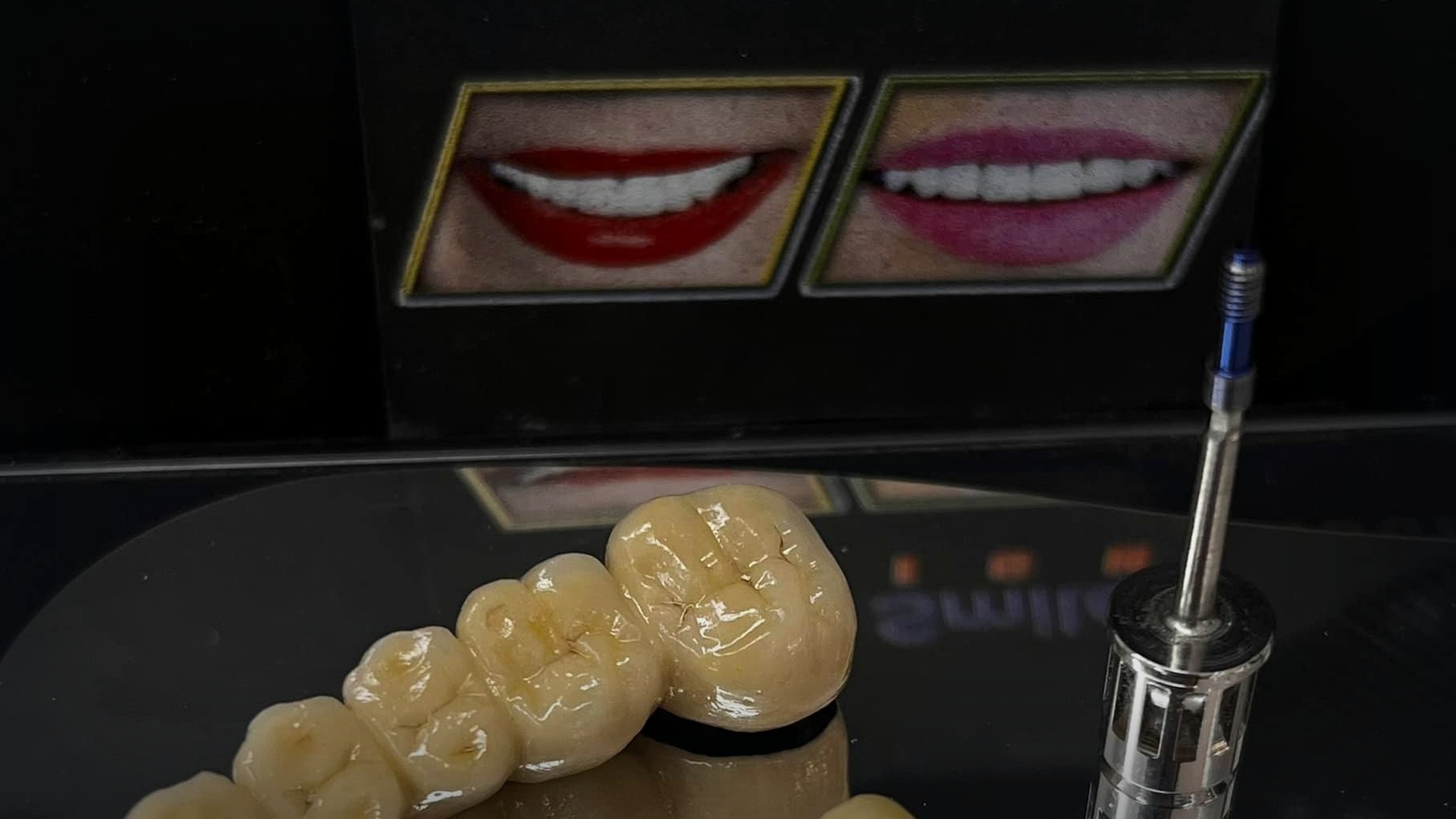
CAD design can become a clinical control point
For aesthetic cases, limited space or dentists requesting design only, the design can be reviewed before final production.
shape, proportions, embrasures
proximal and occlusal
thickness and material limits
deliverable file according to request
Product matrix
Indications, data and control for each category
Dentists should quickly understand the difference between categories, the data that reduces ambiguity and the controls performed before delivery.
| Category | When indicated | Data to send | Magic Smile control |
|---|---|---|---|
| Veneers | Anterior aesthetics, shape, shade and proportion corrections with conservative preparation. | Photos, shade, smile line, model or scan and aesthetic objective. | Shape, texture, symmetry, readable margins and harmony with adjacent teeth. |
| Zirconia crowns | Aesthetic and resistant crowns when space, abutment and occlusion support the indication. | STL or impression, abutment, bite, shade, antagonist and occlusal notes. | Marginal fit, thickness, anatomy, contacts and shade according to indication. |
| Zirconia bridges | Fixed bridges requiring aesthetics and strength, according to span and support. | Full model or scan, bite, span, shade and edentulous space information. | Passivity, emergence profile, contacts, connectors and adjustment risk. |
| Metal-ceramic work | Crowns and bridges with metal support when the case requires a robust controlled solution. | Preparations, space, shade, span, occlusion and aesthetic requirements. | Support, ceramic layering, margins, contact points and finishing. |
| Splints | Protection, stabilization, retention or functional planning. | Arches, bite, clinical objective, requested thickness and contact preferences. | Adaptation, thickness, extension, comfort and stability on the model. |
| CAD design | For dentists who only need design, without full laboratory production. | STL, indication, intended material, export parameters and laboratory requirements. | Anatomy, space, virtual contacts, margins and deliverable file according to request. |
Key facts
Clinic workflow
We receive case data: STL, impressions, models, photos, prescription or requested deadline.
We review indication, space, margins, occlusion, shade and possible technical risks.
We produce through a digital, conventional or mixed workflow; on request we provide CAD design only.
We check morphology, contacts, margins and packaging before delivery.
| Indication | Use | Useful data |
|---|---|---|
| Veneers | Anterior aesthetics | Photos, shade, minimal space |
| Zirconia | Aesthetic crowns and bridges | Clear margins, occlusion, shade |
| Metal-ceramic | Crowns and bridges with metal support | Space, abutment, shade, span |
| Splints | Occlusal protection or planning | Model, bite, clinical objective |
| CAD design | Design-only service for dentists | STL, indication, export parameters |
Control and safety
Marginal fit and quality control
Verified Marginal Fit
Magic Smile Design SRL works as the dentist's technical partner: we review the case before production, clarify limits, select the appropriate solution and inspect the work for a more predictable delivery.
Natural And Functional Morphology
Magic Smile Design SRL works as the dentist's technical partner: we review the case before production, clarify limits, select the appropriate solution and inspect the work for a more predictable delivery.
Controlled Contacts And Occlusion
Magic Smile Design SRL works as the dentist's technical partner: we review the case before production, clarify limits, select the appropriate solution and inspect the work for a more predictable delivery.
Documented Clinic Communication
Magic Smile Design SRL works as the dentist's technical partner: we review the case before production, clarify limits, select the appropriate solution and inspect the work for a more predictable delivery.
Documented quality
Quality control should leave a technical trace
We do not rely on generic perfection claims. Checks are structured so the dentist knows what was received, what was controlled and where a clinical or technical limit exists.
Case intake
Prescription, digital or analog data, photos and deadline are tied to the same work order.
Pre-production review
Margins, space, occlusion, shade, material and span are checked before fabrication.
Production notes
Technician observations preserve case context and reduce late interpretation.
Final control
Morphology, contacts, marginal fit, finishing and packaging are treated as control points.
Clinical feedback
When the dentist reports an issue, the case becomes input for improving the next protocol.
Risk policy
Remakes should be analyzed, not hidden
A serious policy starts from the cause: missing data, changed indication, production error, clinical modification or damage after delivery.
- keep the original work when possible
- photos and explanation of the issue
- review prescription and received data
- documented decision for adjustment or remake
Quick checklist
Case ready for the laboratory
Case planning
Request technical feedback before production
For aesthetic, implant, long-span or limited-space cases, send the main data and receive technical questions before work starts.
Send indication, material, available data and requested deadline.
The clearer the case is at intake, the better the laboratory can control cost, risk and delivery.
Clinical Q&A
FAQ
How does Magic Smile help reduce remakes?
Through technical review before production, margin clarification, space control, shade communication and contact verification.
Which workflows do you accept?
Digital, conventional or mixed, depending on the data received and the technical safety of the case.
Can I request CAD design only?
Yes. For dentists who need design only, we prepare CAD design according to the indication and requested parameters.
Do you work directly with patients?
No. Magic Smile Design SRL is a dental laboratory for dentists and dental clinics.
Related clinical topics
Discuss a case
Magic Smile Design SRL works as the dentist's technical partner: we review the case before production, clarify limits, select the appropriate solution and inspect the work for a more predictable delivery.